
Forfatter: Cathrine Stenrøs
Fiskeriminister Karen Ellemann (V) til møde med Marine Ingredients Denmark på TripleNine’s fabrik i Thyborøn
2017.11.27
Fiskeriminister Karen Ellemann lagde fredag vejen forbi TripleNine A/S i Thyborøn, hvor hun mødtes med bestyrelsen for Marine Ingredients Denmark (MID). Det blev til en god og konstruktiv debat om aktuelle emner inden for industrifiskeriet som er hele eksistensgrundlaget for de to medlemmer der tegner MID, FF Skagen A/S og TripleNine A/S, der både samlet set og hver for sig, er blandt verdens største leverandører af marine fiskeproteiner og omega-3 fedtsyrer.
Der blev livligt diskuteret rådgivning, forvaltning af fiskekvoter, betydning af Brexit, ny fiskeripakke m.m.
Besøget sluttede med en rundvisning på TripleNine’s fabrikker, hvor Fiskeriministeren vist stor interesse for og spørgelyst til processen.
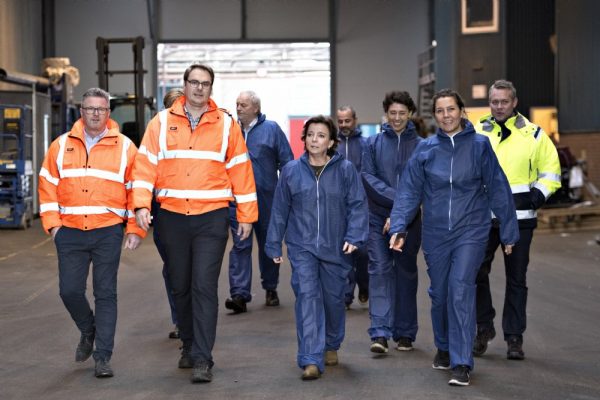
På billedet ses (fra venstre) Peter Jensen, CEO TripleNine Fish Protein, Henrik Sørensen, COO TripleNine Fish Protein, Jens Borup, Bestyrelsesformand FF Skagen A/S, Karen Ellemann, Fiskeriminister, Ron Amir, Særlig Rådgiver, Anne Mette Bæk, Direktør Marine Ingredients Denmark og Klaus Kristoffersen, Kvalitetsdirektør FF Skagen A/S.
Warning: Undefined array key "ssba_bar_buttons" in /var/www/maring.org/public_html/wp-content/plugins/simple-share-buttons-adder/php/class-buttons.php on line 602


Miljøstyrelsens BREF-dag 2017
2017.11.7
Hvert år afholder Miljøstyrelsen en BREF-dag dedikeret til at oplyse virksomheder, kommuner, brancheforeninger og øvrige interessenter om, hvordan revisionen af IED-direktivet foregår, og hvordan disse interessenter kan få indflydelse på processen og de endelige bindende BAT-konklusioner.
I år var vi inviteret til at holde et oplæg om den forberedende fase i arbejdet med BREF. På vegne af både Marine Ingredients Denmark og EUfishmeal gav Anne Mette de godt 200 deltagere i dagen et indblik i, hvordan vi som brancheforeninger har forberedt os på den kommende revision af “vores” BREF for slagterier og animalske biprodukter. Vi har i MID og EUfishmeal lagt meget energi i arbejdet, de nye BAT-konklusioner kan have stor indvirkning på indretningen af vores fabrikkers produktion i fremtiden.
Se alle præsentationerne fra dagen HER.
IFFO announces incoming President and Vice President
2017.10.24
Following elections for the new IFFO Management Board (starting 1st January 2018), IFFO is pleased to announce that the incoming President is Eduardo Goycoolea and Vice President is Anne Mette Bæk. IFFO’s Producer members elected representatives for their countries to the board in September and the President and Vice President were confirmed at the IFFO Board Meeting on 23rd October. The full Management Board for 2018-2019 is as follows:
- Peru: Humberto Speziani, Walter Martinez, Gonzalo De Romaña and Fernando Ribaudo
- Chile: Felipe Zaldivar, Eduardo Goycoolea, and Juan Carlos Ferrer
- Denmark: Anne Mette Bæk
- Norway: Arnt-Ove Hoddevik
- Iceland: Johann Peter Andersen
- USA: Jostein Rortveit
- Rest of the World: Mike Copeland and Helge Korsager
FIFO figures below 1 for salmonids in 2015
2017.10.16
IFFO, The Marine Ingredients Organisation, has calculated new Fish In: Fish Out ratios (FIFO) for 2015 and for the first time FIFO figures for salmonids are below 1. Calculated with FAO data, Fish In: Fish Out ratios (FIFO) have been used by as a way of reviewing the consumption of wild fish by the sector since the 1990s. Salmonids have drawn attention on this subject in the past, and have been criticised previously for their use of fishmeal and fish oil. In 2015 the sector produced more fish protein than it consumed.
Previously, IFFO provided figures for FIFO for 2000 and 2010 and has now updated these using 2015 production and consumption data. The 2015 figures retain the trend of reducing FIFOs seen between 2000 and 2010. Overall fed aquaculture FIFOs have declined from 0.63 to 0.33 to 0.22 over the period. Succinctly put, this means that for every 1kg of wild fish consumed by the aquaculture industry as feed, a total of 4.55kg of farmed fish was produced in 2015. As aquafeed volume has continued to increase against a background of finite fishmeal and fish oil supply, we may expect that in 2017 the figure is even higher.
IFFO’s Technical Director Dr Neil Auchterlonie, who calculated these figures noted “the fishmeal industry supports the production of a significantly greater volume of protein for humanity than would be supplied merely through the direct consumption of the fish used as raw material in the production process. This represents a significant contribution to global food security.”
Source: IFFO
Submariner conference – Better off Blue
2017.9.29
Marine Ingredients was happy to be invited to present the industry’s views in the 2nd Submariner Conference ”Better off blue” in Berlin Wednesday September 27.
The session ”Changing markets for Marine Protein sources in feed” gave some interesting views on the current and expected market of marine raw material.
Are alternatives to fish oil really more sustainable?
2017.6.22
A recent event which claimed that a new alternative source of omega-3s in aquafeeds is more sustainable than fish oil was “misleading”, according to Neil Auchterlonie, Technical Director of IFFO.
The global annual supply of fish oil, at c.1 million tonnes or a little under, is not enough to meet the demand of the growing aquaculture industry. That much is clear. IFFO acknowledges the importance of alternative ingredients for both fishmeal and fish oil in support of aquaculture, but within its “As Well As, Not Instead Of” approach to the presence of those other ingredients in the marketplace.
The important thing to recognise is the need for a basket of ingredients for fish and animal feed in the future, and the requirement for those industries to work together and be supportive in achieving the goal of improved protein supply. Progress will be hindered where one sector attempts to advance its own product at the expense of another – and particularly where the information provided on that sector is inaccurate.
Although inclusion rates have declined over time, as a response to global supply and natural fluctuations in raw material availability, fishmeal and fish oil remain essential nutrients in aquafeeds to meet the requirements of many farmed aquatic species. The other aquafeed ingredients currently incorporated or planned for incorporation in the future, should be complementary to the marine ingredients that are the foundation for modern fed aquaculture systems. Overall, such a complementary approach supports the need for additional protein supply for humanity, provided by aquatic systems with all the environmental benefits that come from fish production when compared with terrestrial farming systems, such as improved feed conversion ratios and protein utilisation efficiencies.
Papers such as that produced by Sprague et al., 2016 highlight that fish oil, and the provision of omega-3 fatty acids in particular, may be the ingredient at the forefront of a restriction to the supply of aquafeed ingredient requirements. It is therefore no surprise that companies focus on alternatives to produce these much-needed compounds in an attempt to augment the annual supply that is already produced by the fishmeal industry.
However, a recent event in Bergen which outlined a joint venture by DSM and Evonik, which aims to provide material that alleviates some of that pressure on omega-3 fatty acid supply, was misplaced in its attempt to position this alternative as a more sustainable option than fish oil. An example of the negative messaging is the statement that the algal oil will be produced “to keep up with the increasing demand for EPA and DHA omega-3 fatty acids without endangering fish stocks, while contributing to healthy animal nutrition as well as to the ecological balance and biodiversity of the oceans” (emphasis mine). Further we come across reference to: “high purity, free from fish-based ingredients and genetic modification”, “by replacing fish oil by the algal oil, the fish-in fish-out ratio could substantially be reduced”, “1kg of …algal oil can replace 60kg wild catch fish”, “our joint venture contributes to five United Nations Sustainable Development Goals” (one of which is No.14, Life Below Water). Over 40% of the world’s fishmeal supply comes from sources certified as sustainable.
The implication from the Bergen presentation is that fish oil is in some way environmentally-damaging, impure as an ingredient, and its use in aquafeeds is thus questionable. At IFFO we find this approach and implication inaccurate, and, given the context and location of the event the wording may also be described as inappropriate. Bergen could be viewed as the capital of the salmon farming industry in Norway, an industry that was built on fishmeal and fish oil. Algal oil production may, at some point, reach an annual production volume that reaches the quantity of fish oil – and that is very much needed for aquaculture – but it is several years from that position and should not seek support at the expense of an industry that has actually created a market for its own product, with misinformed and poorly researched statements.
IFFO has been representing the fishmeal industry since 1959, so we have experience and knowledge about the sector developed over several decades, and have been countering any inaccurate information that has been circulating about the industry equally as long. We understand the pattern of raw material supply into production and communicate extensively on the subject. Many of the whole fish used for fishmeal and fish oil production are the small pelagic species originating from the forage fish stocks. They are typically characterised as fast-growing, early maturing species, for which there are no direct human consumption markets (if there were then they would be used for this as prices are better). They are comparatively easily managed fisheries (in comparison to more complex multiple stock fisheries), and recent science is now showing that stock levels are largely driven by environmental factors (rather than fishing) and that the impact of fishing on mammalian and avian predators (eg dolphins, seals, pelicans) is much less than has previously been stated. Current estimates, however, are that globally about 67% of the raw material supply comes from whole fish – the remaining proportion comes from the processed byproduct from other seafood (frames, heads, offal, trimmings, etc) and so is an excellent technique for producing a product that supports global food production from an unutilised resource. The percentage of byproduct used in production varies by region, and there are notable variations around this figure, such as Europe, in which a figure of 54% from byproduct has been calculated.
Finally, with regard to the certification of the available ingredients for aquafeed and other animal feeds available, it is interesting to note that the global supply of fishmeal and fish oil significantly outperforms other feed ingredient supply when it comes to the volumes of certified product available. The industry can quote a volume of certified product supply that currently exceeds 40% with a continued upward trend that is supported by the use of Fisheries Improvement Projects (FIPs) as a mechanism that brings advances in fisheries management, and progression in marine ecosystem and socio-economic sustainability. In this way, the developing industry is actually enhancing the marine environment.
The developing algal industry is some way from achieving this kind of environmental performance, and will not be without its own environmental impacts (eg energy use) for which it could equally be criticised.
Source: TheFishSite.com and IFFO.
Seneste kommentarer