
Forfatter: Anne Mette
Hvad bliver tobiskvoten i 2019?
2018.12.5
DTU Aqua har netop offentliggjort resultaterne af et forskningsprojekt, der på baggrund af historikken for bestanden af tobis, forskellige biologiske parametre samt miljømodeller giver en kvalitativ prognose for tobisrekrutteringen i 2018. Da tobiskvoten for 2019 er betinget af størrelsen på tobisrekrutteringen i 2018, giver prognosen en første indikation på tobiskvotens størrelse i 2019.
Prognosen siger, at der er stor sandsynlighed for en høj eller medium rekruttering i 2018, hvilket kan ses i nedenstående figur.

Den grønne linje med kraftige toppe, senest i 2009, i figuren herover, viser den historiske tobisrekruttering samt forudsigelsen (prognosen) for tobisrekruttering i 2018. Tidsserien er udarbejdet på baggrund udregninger fra ICES HAWG-arbejdsgruppen (grøn linje) og efter korrektioner af bestandsvurderingerne. De viste sandsynligheder for rekrutteringen af tobis i 2018 er på figuren angivet i tre niveauer – høj, medium eller lav rekruttering. På figuren er de tre niveauer vist som vandrette streger. Kilde: Mark R. Payne, DTU Aqua.
Læs mere om nyheden på DTU Aquas hjemmeside, hvor prognose-beregningerne er beskrevet i detaljer.

Figuren herover viser den samlede værdi af fiskemel og -olie produceret fra tobislandinger til de danske havne i årene 2010-2018. Tobis er historisk set den vigtigste fiskeart for de danske fiskemel og -oliefabrikker, som årligt producerer over 200.000 tons fiskemel og fiskeolie. Årligt eksporterer de danske fabrikker fiskemel og -olie til en samlet værdi af over 3 mia. kr. til mere en 60 lande verden over.


The 2018 Annual Economic Report on the EU Fishing Fleet (STECF 18-07)
2018.10.9
The Baltic Herring and the dioxine challenge
2018.10.1
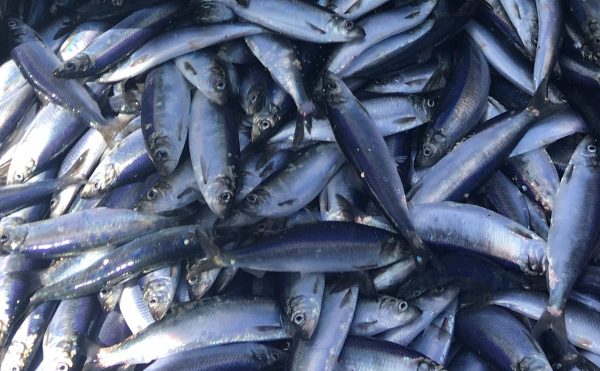
A new paper “Food security and safety in fisheries governance – A case study on Baltic herring” uses a participatory backcasting exercise to define a desirable future vision for the use of Baltic herring catch and to develop pathways of actor-specific governance actions to increase the use of the fish as a safe-to-eat food. To read the paper click here
The results reveal that increasing the contribution of forage fish, such as Baltic herring, to food security entails a paradigm shift in fisheries governance that involves 1) inclusion of well-defined objectives for catch use in the EU CFP and the related regional multiannual plans, 2) broadening the scope of the MSY-driven governance and management to one that addresses catch use, and 3) proactive catch use governance.
Results in relations to fishmeal and fish oil were:
“Owing to the dioxin problem, reducing Baltic herring to dioxin-free fishmeal and oil was considered an important way, especially in the short term, to increase the contribution of Baltic herring to food security.”
“Finally, actions to create a market for Baltic herring fishmeal and oil for human consumption were identified. These included responding to the growing demand for healthy fish products, and investing in new production lines or, alternatively, revising regulations to allow the production of fishmeal and oil for human consumption in the same production line as for feed.
“The Danish factories don’t produce fishmeal and oil for human consumption, because of the legal regulation. They are not allowed to use it. Because they are considered by-products. Completely same factories in Peru can produce for human consumption, but not in Denmark. But they are trying to change it. It should be the products, the quality of the products that decides whether it can be used or not.” Representative of fishmeal and oil industry, Denmark”
Seneste kommentarer