Forfatter: James Hinchcliffe
Tobissæsonen 2025: Branchen står over for fortsatte udfordringer med lukninger i Storbritannien
2025.8.21
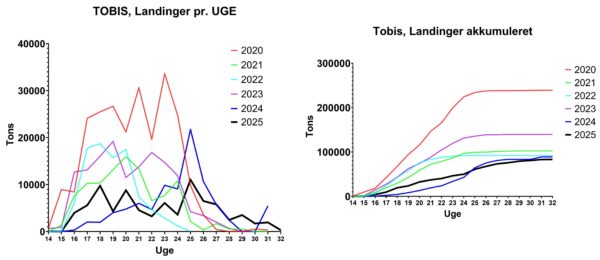
Tobissæsonen 2025, der sluttede i begyndelsen af august, blev en udfordrende sæson for den danske fiskemelsindustri. Det skyldes i høj grad lukningerne af britiske farvande for tobisfiskeri, som har betydet reduceret adgang til råvarer. I alt modtog MID’s fabrikker 85.101 tons tobis i 2025, hvilket svarer til et fald på 5.000 tons i forhold til sidste år. Dette underskud understreger de vanskeligheder som fiskere, der opererer uden adgang til britiske farvande, står over for.
Samtidig var der også positive udviklinger, der viser fiskeriets modstandsdygtighed. Kvoten for europæisk tobisfiskeri i 2025 blev fastsat til 110.078 tons, og selvom de samlede landinger var lidt lavere end i 2024, var udnyttelsen af kvoten betydeligt højere. Fartøjerne landede i Danmark for 85.101 tons, mens der i Norge blev landet 20.187 tons. Sammen udgjorde dette 105.288 tons eller 96% af den samlede kvote. Til sammenligning blev kun ca. 60% af kvoten landet i 2024. På trods af de omfattende lukninger i britiske farvande var europæiske fiskere derfor i stand til at udnytte kvoten mere effektivt i år.
Det står klart, at lukningen af britiske farvande ikke længere er en kortvarig udfordring, men en strukturel ændring, der vil præge tobisfiskeriet i de kommende år. For at sikre, at bestandene forvaltes ansvarligt, samtidig med at råvareforsyningen til industrien opretholdes, vil det kræve både videnskabelig tilpasning og fortsat dialog mellem politiske beslutningstagere, fiskere og forarbejdningsvirksomheder.


MID har indsendt høringssvar over EU maksimalgrænseværdier for MOAH/mineralolie i fødevarer
2025.6.30
Marine Ingredients Denmark har den 30. juni 2025 fremsendt høringssvar til fødevarestyrelsen høring over EU maksimalgrænseværdier for MOAH/mineralolie i fødevarer.
Vi ser reguleringen af MOAH-niveauer i fødevarer som et vigtigt led i arbejdet med at beskytte forbrugernes sundhed. Vi bakker op om indførelsen af grænseværdier, så længe de afspejler de tekniske og analytiske realiteter, særligt for marine olier, hvor analysemetoder stadig er under udvikling. Vi anbefaler en trinvis og fleksibel implementering, der muliggør løbende metodisk videreudvikling og validering af analyser tilpasset marine matricer. Endelig vil vi understrege behovet for en toksikologisk vurdering og prioritering af MOAH-komponenter, så reguleringen målrettes de forbindelser, der udgør den største sundhedsrisiko.
Læs hele høringssvaret her: MID høringssvar til høring over EU maksimalgrænseværdier for MOAH-mineralolie i fødevarer June 2025
Farmed Atlantic Salmon Safe but lower on Omega 3s, Long-Term Study Finds: MIDs analysis
2025.6.11
A major long-term study from the Institute of Marine Research in Bergen has revealed how the quality of farmed Atlantic salmon has changed over the past 16 years. Published in the Journal of Agriculture and Food Research, the study highlights a clear trade-off: salmon fillets today are safer to eat, with lower levels of harmful contaminants, but they also contain fewer important nutrients—especially the omega-3 fatty acids EPA and DHA.
In the past, feeds for Atlantic Salmon were based on high inclusion of marine ingredients like fishmeal and fish oil, sourced from pelagic fish, which are rich in the long-chain omega-3s that are important to both fish health and human nutrition. But as global aquaculture expanded and marine resources became more limited and costly, feed producers began replacing fishmeal and fish oil with plant-based ingredients such as soy and rapeseed oil. By 2020, the share of marine ingredients in the diets of Atlantic Salmon was down to 24% from, 90% in the 1990s.
To understand this in detail, researchers at IMR analyzed nearly 7,000 salmon fillets, 900 feed samples, and 600 samples of raw feed materials between 2006 and 2021. The researchers found that omega-3 levels in feed dropped significantly between 2006 and 2014, then stabilized, which mirror a steep decline in marine oil inclusion in feeds between 2000 and 2020. The stabilization after 2014 likely reflects industry efforts to ensure salmon still receive the minimum levels of omega-3s needed for healthy growth and performance. At the same time, the study found contaminant levels—such as dioxins, PCBs, mercury, and arsenic— decreased significantly over the same period in both feed and fillet samples. These contaminants were associated to marine-based ingredients, which, like all natural sources can be exposed to environmental pollutants.
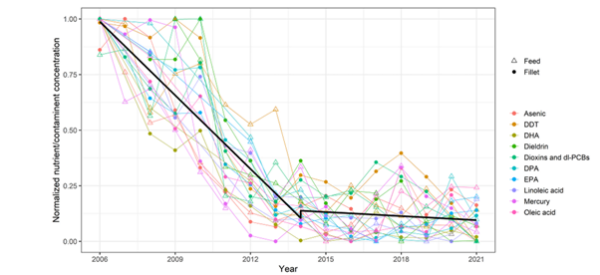
Trends in selected nutrients and contaminants in fish feed and Atlantic salmon fillets from 2006 to 2021
Since 2002, the European Union has enforced strict feed and food legislation that sets maximum limits for undesirable substances in feed materials. The implementation of this regulatory framework has played a central role in ensuring that products entering the aquaculture value chain meet stringent safety standards.
In parallel, the European marine ingredients industry has made substantial progress in eliminating contaminants such as dioxins and PCBs from fishmeal and fish oil. Through rigorous sourcing practices, improved processing technologies, and industry-led quality assurance schemes, the sector has significantly enhanced the safety profile of marine-derived feed ingredients. As a result, the situation today is far more controlled and transparent, with industry and regulators working together to ensure that marine ingredients continue to be both safe and nutritionally valuable components of aquafeeds.
While the biggest shifts in nutrient and contaminant levels took place between 2006 and 2014, the period since then has been marked by greater stability and consistency. These findings serve as a reminder of the strategic role marine ingredients play in aquafeeds—not just for supporting fish growth and health, but also for delivering nutritious seafood to consumers.
Baltic herring processing contributes to regional food security – new report
2025.5.1
A newly published report from RISE Research Institutes of Sweden, “Fishmeal and oil from Baltic Sea herring: current uses and challenges for full transparency” , provides a detailed examination of how herring caught in the Baltic Sea is processed and utilized across sectors, particularly aquaculture. Commissioned by WWF Sweden, the study draws on both industry data and stakeholder input from across the fishmeal, feed, and aquaculture supply chain.
The report’s primary focus is to assess the fate of industrial landings of Baltic herring and to identify the key barriers to full traceability through the value chain. The findings confirm that while fishmeal and oil producers are able to deliver detailed sourcing data, the next stages—particularly feed production—remain a critical bottleneck in efforts to trace raw materials to specific species, stocks, or end markets.
Measurable Use of Baltic Herring in Aquaculture
New estimates presented in the report suggest that Baltic herring can indeed play a traceable and measurable role in supporting salmonid aquaculture in both Norway and Sweden. One Norwegian producer reported that approximately 0.015 kg of live-weight Baltic herring was used per kg of live-weight salmon or trout in 2023. In Sweden, the estimated use of Baltic herring in aquafeeds was approximately 650 tonnes in 2023, corresponding to around 0.08 kg of live-weight Baltic herring used per kg of live-weight rainbow trout produced in Swedish aquaculture.
This use represents a form of net protein production from a local marine resource that is not generally recommended for direct human consumption in large quantities due to persistent contaminants such as dioxins. Through processing, the fishmeal industry is able to reduce these contaminants and valorize the raw material into a high-quality source of protein and lipids for aquafeeds that is then safe to enter the value chain. Although not a central focus of the report, the data suggest that Baltic herring processing contributes in a measurable way to regional food security.
Sector-Level Destinations: Aquaculture Dominates
Using mass-balance data from selected processing facilities, the report finds that the majority of Baltic herring fish oil is used in aquaculture (approximately 99.8%), with fishmeal also predominantly going to aquaculture (69.3%), followed by pet food and agriculture.
The report also highlights that while multiple factories around the Baltic Sea process pelagic species into fishmeal and oil, the level of detail in reported data varies substantially by country and company. In one case, only one national dataset (from Denmark) provided estimates sufficient to support downstream analysis of aquaculture use.
Traceability Bottlenecks in the Feed Sector
The report notes that while feed producers are legally required to maintain records of raw material sourcing, detailed stock-specific information is often difficult to extract from current internal systems. In most cases, data on the use of Baltic herring was either unavailable or only shared as rough estimates, often requiring manual compilation. This variation in data accessibility and reporting practices presents a challenge for full transparency
Moving Toward Improved Transparency
The report recommends feed producers to adopt more structured data management to enable better traceability, and that certification schemes consider stronger requirements for marine ingredient disclosure. While new standards, such as ASC’s updated Feed Standard, may offer improvements in the future, their effectiveness in delivering stock-level transparency remains to be seen. Importantly, the report also notes improvements compared to earlier studies, citing more granular data from some industry participants and a more detailed picture of Baltic herring’s contribution to aquaculture supply chains.
Tobissæsonen er i gang: Tobislandinger i 2025
2025.4.9
Sandeelsæsonen startede i år den 1. april. De gældende betingelser for sandeelfiskeri i 2025 fremgår af bekendtgørelse nr. 12 om øjeblikkelig regulering, som kan læses på Fiskeristyrelsens hjemmeside– click here.
ICES’ rådgivning om sandeelfiskeri i de enkelte forvaltningsområder i 2025 kan læses og downloades fra ICES’ hjemmeside – here.
DTU Aquas tobis-skrabningsekspedition , der blev gennemført i november-december 2024, viste et relativt lavt tilskud af ungfisk til bestanden. På baggrund heraf og den biologiske rådgivning er den samlede danske tobis-kvote for 2025 fastsat til 102.639 ton , hvilket svarer til en reduktion på 17,2 % i forhold til sidste års fiskerimuligheder
Nyheder i voldgiftssagen UK-Sandeel (Den Europæiske Union mod Det Forenede Kongerige Storbritannien og Nordirland) i tvisten mellem EU og Storbritannien om manglende adgang til britiske farvande for tobisfiskeri findes here.
Tobis landet i uge 27: 3.517 tons.
I alt (uge 14-29): 79.231 tons.
Tobis landet i uge 26 i Norge: 0 tons.
I alt (uge 14-29): 20.186 tons.
I alt for landet: 99.417 tons.
71,98% af den samlede europæiske kvote (110.078) er landet i Danmark. Den danske andel af landingerne er 79,7%, og den norske andel er 20,3 %.
Tobisfiskeriet er i gang – fokus på kvoteudnyttelse og udbytte
2025.4.2
Tobisfiskeriet starter officielt og markerer begyndelsen på en ny sæson i et af de vigtigste fiskerier i Nordsøen. Sæsonen begynder uden adgang til britisk farvand, hvilket fortsat lægger pres på de samlede tilgængelige fangstområder. Ikke desto mindre er der en forventning i erhvervet om, at det vil være muligt at fiske den tildelte kvote.
En afgørelse i voldgiftssagen om adgang til britisk farvand afventes stadig. Afgørelsen forventes at få væsentlig betydning for fremtidige sæsoner og for mulighederne for en mere fleksibel forvaltning og planlægning af fiskeriet.
I år er kvoten (t):
1r: 70.807
2r: 39.159
3r: 0
4r: 0
6r: 112
Fangstniveauerne i tobisfiskeriet har varieret over de seneste fem år og giver et indblik i fiskeriets udvikling:
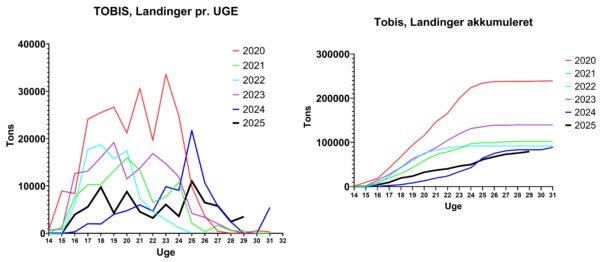
2020: 169.783 tons, 2021: 69.603 tons, 2022: 73.212 tons, 2023: 111.870 tons, 2024: 69.128 tons
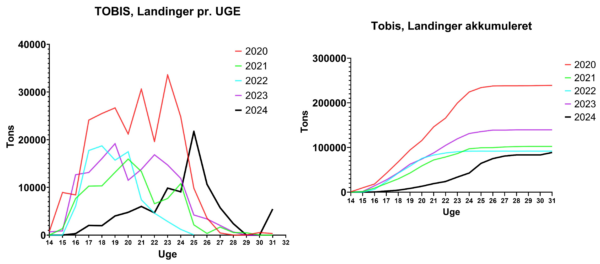
Udviklingen i landinger pr. uge og de akkumulerede mængder over de seneste fem år viser sæsonforløbet og den variation i fiskelandinger, der kan forekomme.
Data viser, at udbyttet pr. fangst af tobis er højere senere på sæsonen, hvilket giver et højere indhold af værdifuld fiskeolie. Denne forskel i udbytte afspejles typisk også i afregningspriserne, hvilket har betydning for både mængden af landinger og den samlede økonomiske værdi af fiskeriet gennem sæsonen.
MID påbegynder samtidig den ugentlige rapportering om tobislandinger, som løbende vil blive opdateret. Rapporteringen vil give et overblik over fiskeriets fremdrift og mængderne, der landes, hen over sæsonen.
Seneste kommentarer