The Danish Industry
Processing
Fishmeal
Fishmeal is a concentrated marine protein made by cooking, drying, and grinding whole fish or fish trimmings. Danish fishmeal typically contains around 71% high-quality, digestible protein, 8% marine oil, and essential minerals. Its superior nutritional profile makes fishmeal a critical ingredient in feeds for aquaculture and livestock. It is especially valuable in diets for young or fast-growing animals — including piglets, poultry, calves, lambs, fish, shrimp, fur animals, and pets — where digestibility and nutrient density are key.
Fishmeal contributes not only to protein levels but also delivers key amino acids, marine lipids, and micronutrients that support growth, immunity, and feed efficiency. As such, it remains a vital component in modern feed formulations and plays an important role in sustainable food production systems.
Fish oil
Fish oil is a 100% marine-derived product rich in long-chain omega-3 fatty acids, primarily EPA and DHA. It is an essential ingredient in aquafeeds, supporting the health, growth, and reproductive performance of farmed fish and shrimp.
Beyond aquaculture, refined fish oil is also used in supplements for human nutrition, valued for its proven benefits to heart, brain, and immune health. Due to its unique fatty acid profile, fish oil cannot be easily replaced by plant-based alternatives, making it a critical component in both animal and human diets. Its dual role in food and feed production highlights its importance in meeting global nutritional needs through efficient, marine-based resources.
Production process
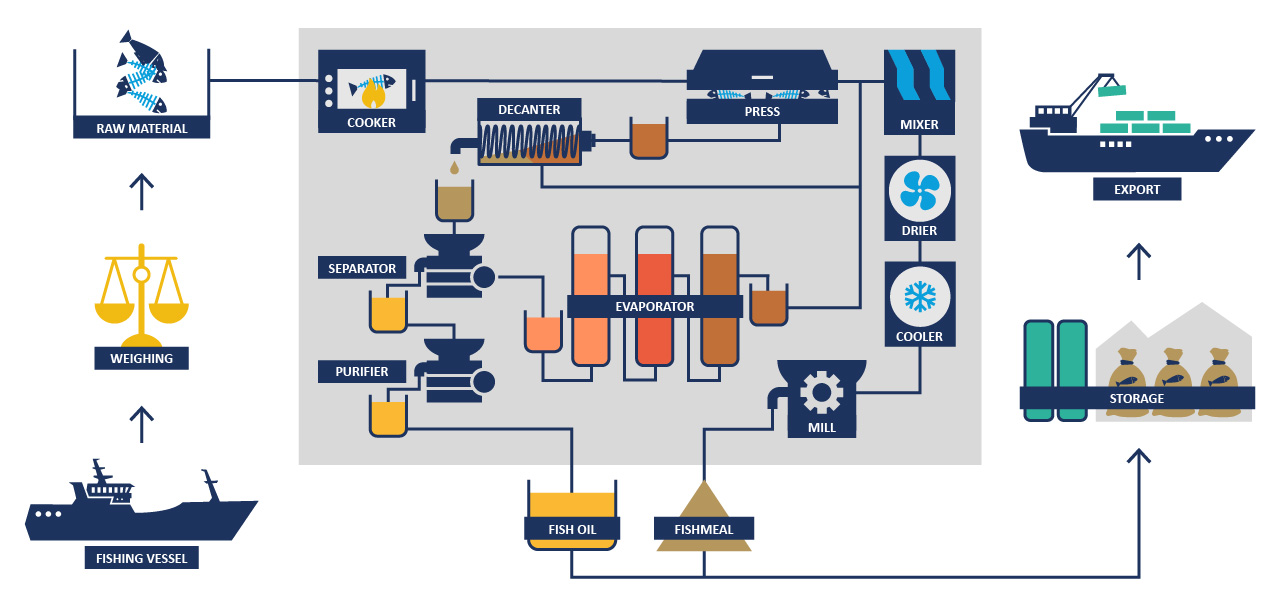
The production of fishmeal and fish oil from small pelagic fish follows a controlled and efficient sequence of cooking, separation, drying, and milling.
- The raw material is first gently cooked using indirect steam, allowing proteins to coagulate and releasing natural oil and water. This creates two fractions: a solid “presscake” and a liquid phase known as “presswater.”
- A decanter is used to remove remaining solids from the presswater, returning them to the presscake. The liquid then undergoes centrifugation to extract the fish oil. What remains — a nutrient-rich liquid called “stickwater” — is concentrated through evaporation into “solubles.”
- These solubles are blended back with the presscake and dried using indirect steam to reach a final moisture content of 5–10%. The dried material is then cooled, stabilized with antioxidants, and finely milled to produce the final fishmeal product.
- Throughout the process, strict quality controls are applied to ensure that both fishmeal and fish oil meet nutritional and safety standards, ready for use in feed and food supply chains.
For a comprehensive overview, please refer to the detailed report by the Nordic Centre of Excellence Network in Fishmeal and Fish Oil. You can access it – Here